From Aruba Central to New Central: How to Evolve Your Network Toward Autonomous Security
For years, HPE Aruba Networking Central has been a go-to platform for the cloud management of enterprise networks, enabling the centralized management of access points, switches, and gateways.
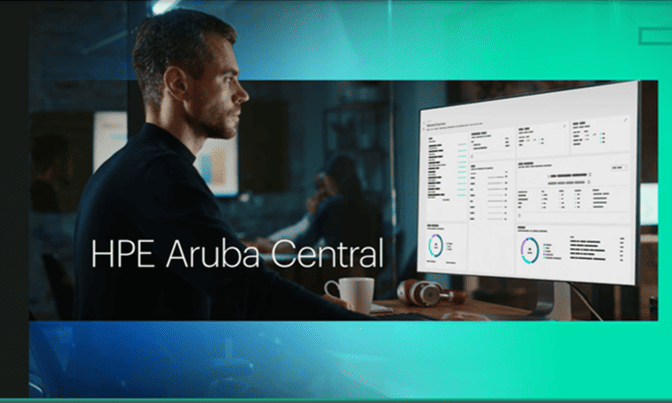
The HPE Aruba Networking ecosystem is now entering a new phase. The evolution to New Central incorporates advanced artificial intelligence, automation, and analytics capabilities to simplify network operations and accelerate incident resolution.
At the same time, HPE is moving toward a progressive convergence of the Aruba and Juniper portfolios, incorporating AI capabilities developed by Juniper into the Aruba ecosystem.
For organizations that already have Aruba infrastructure in place, this evolution does not mean starting from scratch or abandoning existing investments, but rather progressively moving toward a smarter, more automated network model.
1. From a reactive network to an AI-assisted network
The evolution of Central goes beyond a change in interface. The goal is to transform the way IT teams monitor, diagnose, and operate infrastructure.
Greater visibility into the user experience
Modern network operations involve more than just knowing whether a device is connected.
New analytics capabilities provide greater context regarding network status and the user experience, helping to identify issues such as coverage degradation, congestion, or connectivity problems.
This allows troubleshooting efforts to be focused on the actual impact the network has on users and applications.
Natural language assistance
One of the capabilities already available in Central is Networking Copilot, which enables interaction with the platform using natural language to query information and facilitate specific analysis and troubleshooting tasks.
AI thus helps IT teams obtain information more quickly and reduce the time required to investigate specific incidents.
The availability of advanced features depends on the licensing level and the capabilities supported in each environment.
From recommendation to action
The evolution of artificial intelligence goes a step beyond simply detecting anomalies or providing recommendations.
HPE is progressively integrating AI capabilities developed by Juniper—including Marvis Actions—into the Aruba ecosystem; these capabilities are designed to identify specific network issues and automate corrective actions.
These capabilities represent a significant shift in the operational model: moving from a network that detects and alerts to one capable of detecting, analyzing, and acting upon specific issues.
The ultimate goal is to reduce manual intervention and accelerate incident resolution.
2. An evolution that protects the existing investment
For any CIO or infrastructure manager, network modernization must be accompanied by a clear investment protection strategy.
The evolution of the HPE Aruba Networking ecosystem should not be viewed as an obligation to immediately replace existing solutions, but rather as a progressive process of convergence.
Continuity of portfolios
HPE is moving toward greater convergence between the Aruba and Juniper portfolios, aiming to progressively integrate the capabilities and technologies of both companies.
For existing Aruba customers, this means that the evolution does not need to be approached as a radical platform change.
The strategy involves leveraging existing infrastructure and progressively adopting new capabilities as they become available and relevant to each organization.
This convergence also opens up new management possibilities. Among them, HPE has announced the ability to manage certain Aruba switches from the Juniper/Mist platform.
Hardware ready for convergence
Convergence is also beginning to be reflected in hardware.
HPE already offers access points capable of operating with both HPE Aruba Networking Central and Juniper’s Mist platform, opening up new possibilities for evolution and flexibility for customers.
Specific compatibility must always be assessed based on the device model, software version, architecture, and the features being used.
3. New Central: preparing the network today for the future
The evolution toward New Central also presents an opportunity to review the network's structure and operating model.
It is not simply a matter of changing consoles, but of preparing the infrastructure to leverage new capabilities in monitoring, automation, and artificial intelligence.
The Importance of Sites
One of the key changes compared to Classic Central concerns the role of Sites.
In New Central, Sites play a structural role in operations and monitoring. Therefore, organizations transitioning from Classic Central should review how their locations are organized and how devices are assigned.
A proper Site structure provides the necessary context for managing and monitoring the network more efficiently.
Settings, alerts, and reports
The transition also requires reviewing certain operational elements.
Existing configurations should not be viewed as a simple, automatic "one-to-one" migration; the configuration must be analyzed and adapted to the new management model.
Similarly, elements such as alerts, reports, and custom configurations may need to be reviewed or recreated in the new environment.
Therefore, advance planning helps avoid a loss of visibility and reduces risks during the transition.
Floor plans and location information
Floor plans and device location information are also part of the planning process.
HPE provides mechanisms to migrate floor plans from Classic Central to New Central, although this process must be carried out in a planned manner and subsequently validated.
The goal is to preserve the physical context of the infrastructure and leverage it within the new operating model.
4. AOS 10 and New Central: two parts of the same evolution
It is important to distinguish between two related yet distinct concepts.
On one hand, New Central represents the evolution of the management, operations, and observability platform. On the other, AOS 10 marks an evolution in wireless infrastructure architecture and operations.
While both can be part of the same modernization strategy, they must be analyzed independently based on each organization's specific infrastructure, software versions, AP and gateway models, and requirements.
Therefore, before planning a migration, it is essential to analyze the current environment and define a roadmap tailored to each client.
The value of a technology partner
Evolving toward a smarter network requires a vision that goes beyond technology and takes into account each organization’s current environment.
For an IT team, the true value lies in having a strategy that enables the evolution of existing infrastructure without compromising business continuity.
At Instel, we guide our clients through this process, combining knowledge of the current infrastructure with the new possibilities offered by the HPE Aruba Networking ecosystem.