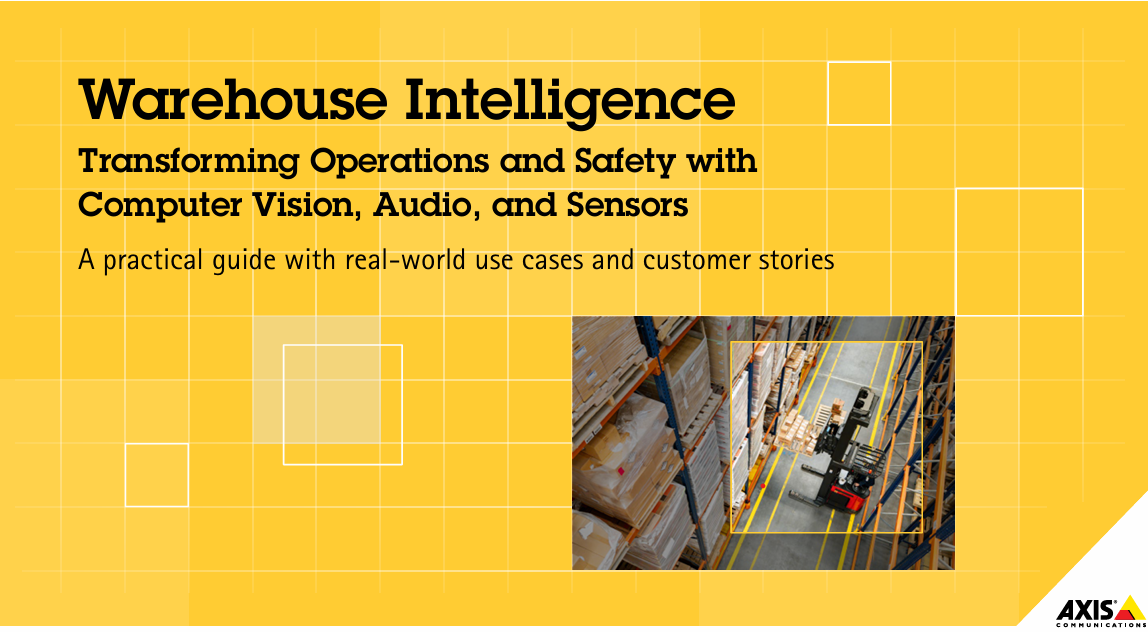
From Video Surveillance to Operational Intelligence: How to Make Your Logistics Centre More Efficient
Harness the power of video analytics, network audio systems and smart sensors to protect your goods, streamline daily processes and gain full control over what happens in your warehouse.
In logistics, cameras no longer have to be limited to recording. Today, they can see, analyse and trigger responses to specific events, becoming sensors capable of providing valuable insights into warehouse security and operations.
This evolution makes it possible to move from traditional video surveillance, primarily focused on perimeter protection, to an infrastructure that provides visibility into what is happening inside the facility.
Axis Communications solutions make it possible to apply this approach to different processes across the logistics environment.
What can video intelligence bring to a warehouse?
A logistics centre brings together multiple processes taking place simultaneously: truck arrivals, loading and unloading, order picking, forklift traffic, goods movement and dispatch management.
Technology can help detect specific situations and trigger automated responses, reducing reliance on manual monitoring.
The goal is not simply to install more cameras, but to ensure that the video infrastructure provides useful insights to support operations.
1. Reduced waiting times at loading docks
Truck waiting times often start before vehicles even reach the loading dock.
Cameras with licence plate recognition can identify vehicles on arrival, while video analytics can be used to detect queues and monitor specific dock occupancy conditions.
This information can be integrated with a Yard Management System (YMS) to facilitate vehicle management and traffic flow within the facility.
The goal: to improve vehicle flow from the entrance to the loading dock and reduce unnecessary manual operations.
2. Greater traceability and less uncertainty when handling claims
When a claim is made regarding an incorrect or damaged order, the lack of objective evidence often forces logistics centres to absorb operational and transport costs in order to preserve the customer relationship.
Axis technology helps reduce this uncertainty by integrating cameras with Warehouse Management Systems (WMS) or barcode readers. This allows video footage to be automatically linked to the history of each shipment or packaging process.
In the event of an incident, simply entering the order number allows the software to retrieve the relevant video evidence within seconds, showing how the operator handled the goods, how they were packaged and the condition of the goods when they left the facility.
This process minimises commercial disputes, eliminates hidden costs and ensures complete operational transparency.
3. Enhanced safety for people and machinery
Workers, forklifts and vehicles constantly share the same space in a warehouse.
Video analytics, radar and network audio can be used to detect specific risk situations, such as vehicles entering unauthorised areas, workers entering restricted zones or potentially hazardous traffic situations.
When a predefined situation is detected, the system can trigger an alert through audio or other connected devices.
Timely detection and alerts help strengthen preventive measures and improve the ability to respond to specific situations.
4. Smoke & Overheating
Protecting a logistics centre requires going beyond conventional systems. Axis technology enables continuous monitoring of critical areas using thermal cameras capable of identifying temperature anomalies before equipment overheats.
In addition, visual analytics devices can detect smoke at an early stage in complex environments, such as outdoor areas or warehouses with high ceilings, providing faster detection than traditional fire detection sensors.
Integrating these solutions adds a layer of automated, real-time monitoring, strengthening facility security and effectively complementing existing fire protection systems.
5. Better Control of Internal Operations
Video intelligence makes it possible to identify operational inefficiencies that go unnoticed through manual monitoring. By automatically analysing activity along operational lines, the system continuously monitors conveyor belt flows to detect blockages or fallen packages, capture shipping codes, and verify load integrity or the condition of security seals.
The real transformation lies not simply in detecting these incidents, but in connecting this data with the warehouse’s existing management systems, such as Warehouse Management System (WMS) or Enterprise Resource Planning (ERP) software. This is where technological integration turns security into a strategic tool for decision-making and productivity improvement.
Security and Privacy by Design
Turning cameras into sensors also raises a fundamental issue: protecting data and safeguarding workers’ privacy.
Axis’ approach includes on-device processing technologies, anonymisation solutions and non-identifying sensors such as radar and thermal cameras.
This makes it possible to design solutions in which security, privacy and cybersecurity are considered from the outset of the project.
Technology alone does not guarantee regulatory compliance: configuration, access policies, data retention and the overall design of the solution are also essential.
The Value of a Technology Partner
The true value of intelligent video surveillance lies in more than simply storing footage.
It lies in obtaining valuable insights into what is happening across the facility and connecting them with business processes.
From access points and loading docks to worker safety, order traceability, load monitoring and conveyor belts, Axis technologies enable a wide range of detection, analytics and integration scenarios.
At Instel, we integrate these technologies to tailor solutions to the specific needs of each facility, connecting security with day-to-day operations and IT requirements.
Do you know how much of your warehouse’s operating costs could be avoided?
Choose your logistics challenge on our interactive map and discover the technology architecture that solves it in minutes.
Implementing these capabilities will transform your video infrastructure: turning it from a regulatory cost into your most valuable operational asset and a guarantee of compliance.